


Framed Prints
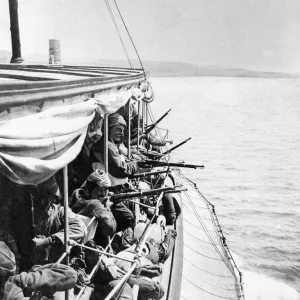
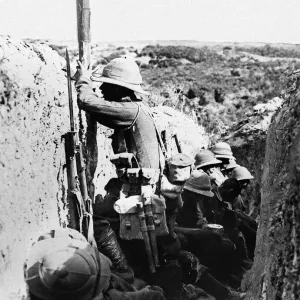
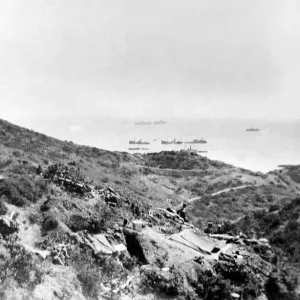
Framed Print of The Gallipoli campaign took place between 25 April 1915 and 9 January 1916
The Gallipoli campaign took place between 25 April 1915 and 9 January 1916. The offensives ultimate aim was to push through the Dardanelles straits and capture Constantinople, the Turkish capital. If a breakthrough had been achieved, the Turks, who were allied with the central powers (Austria and Germany), would have been unable to prevent Britain and France from joining the Russians in the war against Austria-Hungary and Turkey.
After the previous failure of the British and French naval fleets to take the Gallipoli peninsula, the allies felt there was little alternative but to attempt an amphibious landing.
On 25 April two landings were made; the main force of 35, 000 men under Lieutenant General Hunter Weston landed at Cape Helles.
This was supported by a smaller force of 17, 000 men from the Australian and New Zealand Army Corps (Anzacs) under General Sir William Birdwood. This force landed at what became known as Anzac cove, a mile north of their intended destination and surrounded by deep cliffs.
The Anzacs were to move inland and seize the Sari Bari heights but soon met with a Turkish counter attack. By nightfall the Anzacs had suffered 2, 000 casualties and were fighting to stay on the beach.
Much of the failure has been attributed to poor coordination and leadership from the British General Sir Ian Hamilton, who chose to command the whole operation from aboard a ship.
Another 25, 000 men were landed near Anzac Cove and more at Cape Helles in August. The allies made another thrust, but to no avail. Deadlock on the beaches persisted.
The whole offensive was finally called off in December and troops evacuated.
The Gallipoli campaign cost the lives of more than 100, 000 allied and Turkish soldiers with another quarter of a million wounded.
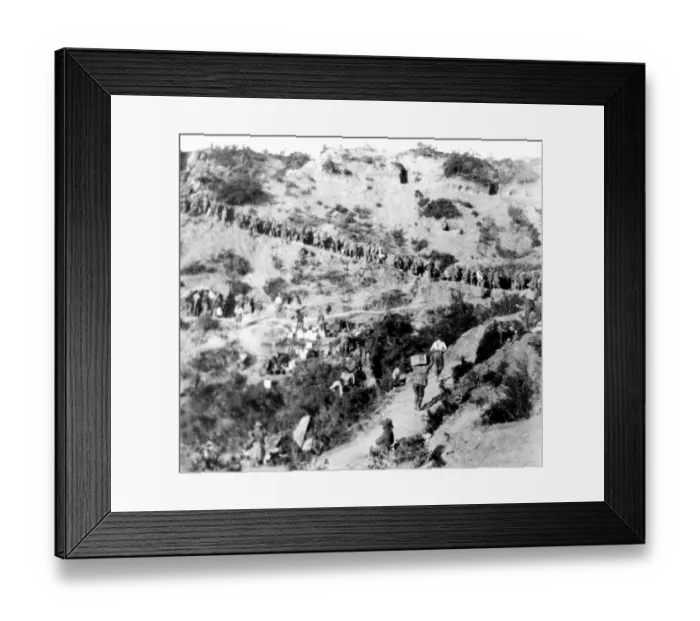
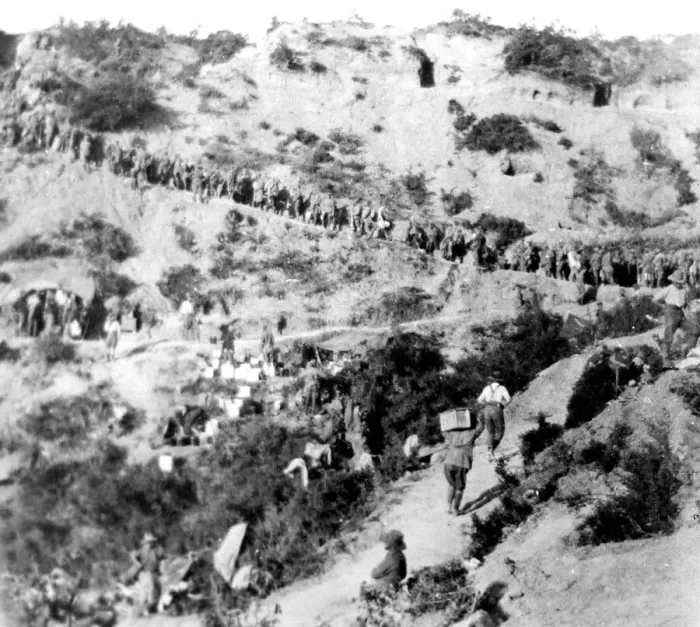
Our Picture Shows: Australian troops march up from the beaches to the frontline trenches on the Dardanelles. © Mirrorpix
Your chosen combination is quickly and professionally made to order, our shipping page has more details
If you are not entirely happy with your items, simply return them to us within 30 days for a replacement or full refund. Please read our full returns policy.
Media ID 21556690
Advance Core18 Dardanelles Marching World War 1
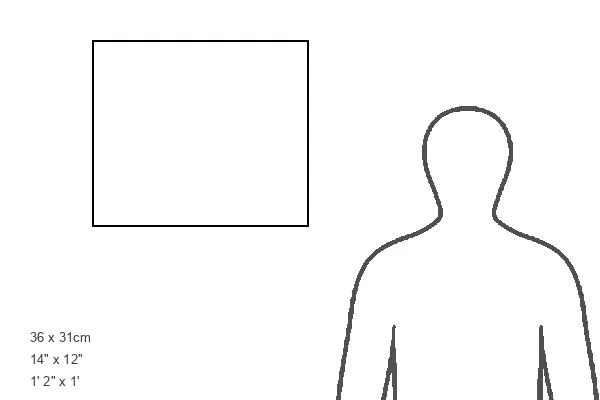
Modern Frame 14"x12" (36x31cm)
Ready to Hang Contemporary Framed Prints adds style, protection, and a polished touch to your space - effortlessly.
Your artwork will be printed as shown in the preview. To adjust please select Edit Printed Image under the Buy button
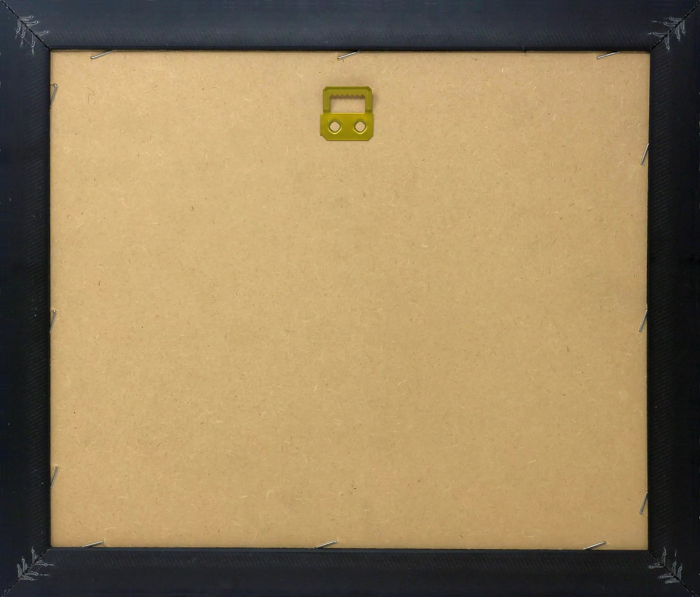
Wood effect frame, card mounted, 10x8 fade resistant photo print. Overall outside dimensions 14x12 inches (36x31cm). Environmentally and ozone friendly, 40mm wide x 15mm Polycore® moulding has the look of real wood, is durable and light and easy to hang. Biodegradable and made with non-chlorinated gases (no toxic fumes) it is efficient; producing 100 tons of polystyrene can save 300 tons of trees! Prints are glazed with lightweight, shatterproof, optical clarity acrylic (providing the same general protection from the environment as glass). The back is stapled hardboard with a sawtooth hanger attached. Note: measurements provided are estimated outer dimensions, which include both the image and the frame. While we aim to keep sizing consistent, exact dimensions may vary slightly due to differences in print size or production requirements, which may result in a variation in the overall size (up to approximately 2.5cm (1"))
These are individually made so all sizes are approximate
Estimated Image Size (if not cropped) is 21.5cm x 19.3cm (8.5" x 7.6")
Estimated Product Size is 36cm x 31cm (14.2" x 12.2")
Features In These Collections
> Mirror > 0100to0199 > 00176